Drowsy Driver Detection Complete Matlab Project Code

ABSTRACT
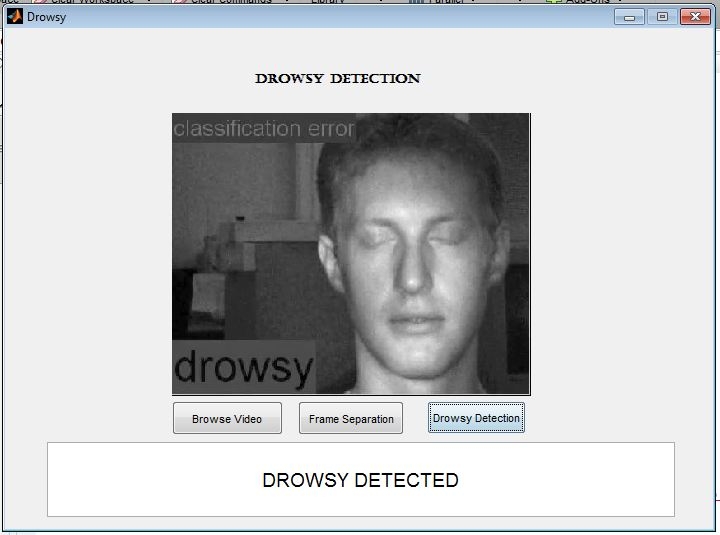
               Driver fatigue is a significant factor in a large number of vehicle accidents. The development of technologies for detecting or preventing drowsiness  has been done thru several methods, some research used EEG for drowsy detection ,and some used eyeblink sensors,this project uses web camera for Drowsy detection.Webcamera is connected to the pc and images were acquired and processed by matlab. The aim of this project is to develop a prototype drowsiness detection system. The focus will be placed on designing a system that will accurately monitor the eye  movements of a driver in real-time. By monitoring the eye movements, it is believed that the symptoms of driver fatigue can be detected early enough to avoid a car accident.

How It Works


 OUTPUT


Contact:  
Mr. Roshan P. Helonde
Mobile / WhatsApp: +91-7276355704
Email: roshanphelonde@rediffmail.com
Share:

Background Subtraction Using Fuzzy Complete Matlab Project code

ABSTRACT
               Background subtraction (BGS) is a commonly used technique for achieving this segmentation. Background subtraction is a widely used approach to detect moving objects from static and dynamic cameras. Many different methods have been proposed over the recent years and there are a number of object extraction algorithms proposed in this survey it has most efficiently constrained environments where the background is relatively easy and static. In this paper, we analysis most popular, state-of- the-art BGS algorithms and propose a neuro fuzzy model for determining thresholds, we examine how threshold algorithm poor their performance. Our method shows that threshold plays a major role in obtaining the foreground segmentation masks produced by a BGS algorithm and our experimental results demonstrate that neuro fuzzy system is much more accuracy and robust than existing system approaches.


OUTPUT


Contact:  
Mr. Roshan P. Helonde
Mobile / WhatsApp: +91-7276355704
Email: roshanphelonde@rediffmail.com
Share:

Distributed System Principles and Paradigms


Download this Book in PDF Click Here
Share:

Network Security Essentials


Download this book in PDF Click Here
Share:

Advanced Computer Architecture and Parallel Processing


Download this book in PDF  Click Here
Share:

A ROBUST DIGITAL IMAGE WATERMARKING BASED ON JOINT DWT AND DCT

ABSTRACT 

               The authenticity & copyright protection are two major problems in handling digital multimedia. The Image watermarking is most popular method for copyright protection by discrete Wavelet Transform (DWT) which performs 2 Level Decomposition of original (cover) image and watermark image is embedded in Lowest Level (LL) sub band of cover image. Inverse Discrete Wavelet Transform (IDWT) is used to recover original image from watermarked image. And Discrete Cosine Transform (DCT) which convert image into Blocks of M bits and then reconstruct using IDCT. In this paper we have compared watermarking using DWT & DWT-DCT methods performance analysis on basis of PSNR, Similarity factor of watermark and recovered watermark.


Contact:  
Mr. Roshan P. Helonde
Mobile: +91-7276355704
WhatsApp: +91-7276355704
Email: roshanphelonde@rediffmail.com
Share:

An Implementation of Audio Noise Reduction from Audio Signals and Speech Signals Using Wavelet Transform

ABSTRACT
           Speech signal analysis is one of the important areas of research in multimedia applications. Discrete Wavelet technique is effectively reduces the unwanted higher or lower order frequency components in a speech signal. Wavelet-based algorithm for audio de-noising is worked out. We focused on audio signals corrupted with white Gaussian noise which is especially hard to remove because it is located in all frequencies. We use Discrete Wavelet transform (DWT) to transform noisy audio signal in wavelet domain. It is assumed that high amplitude DWT coefficients represent signal, and low amplitude coefficients represent noise. Using thresholding of coefficients and transforming them back to time domain it is possible to get audio signal with less noise. Our work has been modified by changing universal thresholding of coefficients which results with better audio signal. In this various parameters such as SNR, Elapsed Time, and Threshold value is analyzed on various types of wavelet techniques alike Coiflet, Daubechies, Symlet etc. In all these, best Daubechies as compared to SNR is more for Denoising and Elapsed Time is less than others for Soft thresholding. In using hard thresholding Symlet wavelet also works better than coiflet and Daubechies is best for all. Efficiency is 98.3 for de-noising audio signals which also gives us better results than various filters.

         Audio noise reduction system is the system that is used to remove the noise from the audio signals. Audio noise reduction systems can be divided into two basic approaches. The first approach is the complementary type which involves compressing the audio signal in some well-defined manner before it is recorded (primarily on tape). The second approach is the single-ended or non-complementary type which utilizes techniques to reduce the noise level already present in the source material—in essence a playback only noise reduction system. This approach is used by the LM1894 integrated circuit, designed specifically for the reduction of audible noise in virtually any audio source. Noise reduction is the process of removing noise from a signal.

PROJECT OUTPUT


Contact:  
Mr. Roshan P. Helonde
Mobile: +91-7276355704
WhatsApp: +91-7276355704
Email: roshanphelonde@rediffmail.com
Share:

MATLAB Code for Ploting Magnitude, Angle, Real, and Imaginary parts of a Signal

Evaluate e^jw/(e^jw-0.5) at 501 equispaced points between [0,pi] and
plot its magnitude, angle, real, and imaginary parts.


%%%%%%%%%%% START %%%%%%%%%%%%%%%
clc; 
w = [0:1:500]*pi/500;
 X = exp(j*w) ./ (exp(j*w) - 0.5*ones(1,501));
 magX = abs(X);
 angX = angle(X);
 realX = real(X); imagX = imag(X);
 subplot(2,2,1); plot(w/pi,magX); grid
 xlabel('frequency in pi units') ; title('Magnitude Part'); ylabel('Ma@tude')
 subplot(2,2,3); plot(w/pi,angX); grid
 xlabel('frequency in pi units'); title('Ang1e Part'); ylabel('Radians')
 subplot(2,2,2); plot(w/pi,realX); grid
 xlabel('frequency in pi units') ; title('Rea1 Part') ; ylabel('Real')
 subplot(2,2,4); plot(w/pi,imagX); grid
 xlabel('frequency in pi units'); title('1maginary Part'); ylabel('1maginary')
%%%%%%%%%%% END %%%%%%%%%%%%%%%

Contact:  
Mr. Roshan P. Helonde
Mobile: +91-7276355704
WhatsApp: +91-7276355704
Email: roshanphelonde@rediffmail.com
Share:

Contact Us

Name

Email *

Message *

Blog Archive

Popular posts