Brain Tumor Detection and Classification using Watershed Technique full Matlab Project Code

ABSTRACT
            A tumor is a mass of tissues that is formed by an accumulation of abnormal cells. Normally, the cells in our body grow, age, die, and are replaced by new cells but the cancer and other tumors damage this cycle. The tumor cells do grow, even if the body does not want them and unlike old cells, these cells do not die easily causing tumor or cancer. The brain is the interior most part of the central nervous system and is an intracranial solid neoplasm. Tumors are created by an abnormal and uncontrollable cell division in the brain. The axial view of the brain image scan has been used. The study of brain tumor is important as it is occurring in many people. In this project, an image segmentation method was proposed for the identification or detection of tumor from the brain. The methodology consists of the following steps: pre-processing by using grey-level, sharpening and median filters; segmentation of the image was performed by thresholding and also by applying the watershed segmentation. Finally the tumor region was obtained with its area.

PROJECT OUTPUT

PROJECT VIDEO


Contact:
Mr. Roshan P. Helonde
Mobile: +91-7276355704
WhatsApp: +91-7276355704
Email: roshanphelonde@rediffmail.com
Share:

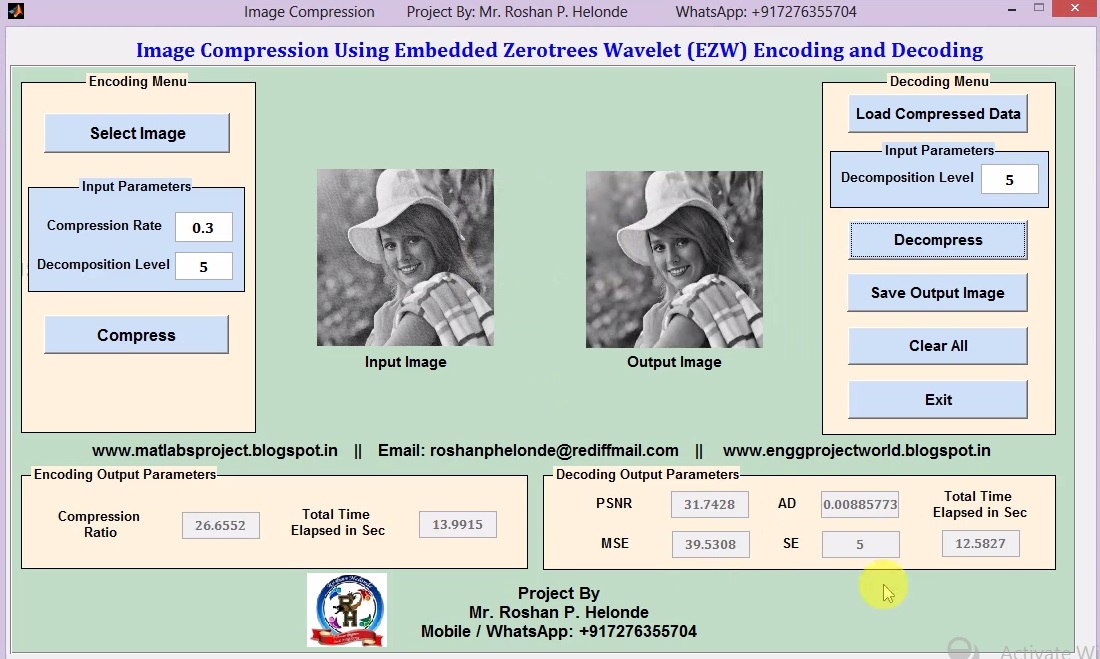
Image Compression Using EZW Embedded Zerotree Wavelet Full Matlab Project with Source Code

ABSTRACT
          Recently, the wavelet transform has emerged as a cutting edge technology, within the field of image compression research. Wavelet methods involve overlapping transforms with varying-length basis functions. This overlapping nature of the transform alleviates blocking artifacts, while the multi-resolution character of the wavelet decomposition leads to superior energy compaction and perceptual quality of the decompressed image. Embedded Zero-tree wavelet (EZW) coder is the first algorithm to show the full power of wavelet-based image compression. The main purpose of this project is to investigate the impact and quality of wavelet for EZW. Meanwhile, we also look into the effect of the level of wavelet decomposition towards compression efficiency. The compression simulations are done on few modalities of images. The qualitative and quantitative results of these simulations are presented. 

PROJECT OUTPUT

PROJECT VIDEO


Contact:
Mr. Roshan P. Helonde
Mobile: +91-7276355704
WhatsApp: +91-7276355704
Email: roshanphelonde@rediffmail.com
Share:

Diabetic Retinopathy Detection Using Matlab Project Code IEEE Based Project

ABSTRACT
        Diabetic Retinopathy is one of the leading impairing chronic diseases and one of the leading causes of preventable blindness in the world. Most of the ophthalmologist depends on the visual interpretation for the identification of Diabetic Retinopathy. But incorrect diagnosis will change the course of treatment planning which leads to fatal results. Hence there is a requirement for a impartial automated system which gives highly accurate results. Early diagnosis of diabetic retinopathy enables timely treatment. To achieve this a major effort will have to be invested into automated screening programs. For automatic screening programs to work vigorously efficient image processing and analysis algorithms have to be developed. Nowadays, Scanning laser ophthalmoscopes (SLOs) can be used for detection of retinal diseases. In this project, we propose a novel framework for the extraction of retinal area of input images and diagnosis of retinal diseases from the retinal area using Support vector machine. The proposed method analyze the retinal images for important features of diabetic retinopathy using image processing techniques and an image classifier based on SVM which classify the images conforming to disease conditions. The features were extracted for classification Process by GLCM.

PROJECT OUTPUT

PROJECT VIDEO


Contact:
Mr. Roshan P. Helonde
Mobile: +91-7276355704
WhatsApp: +91-7276355704
Email: roshanphelonde@rediffmail.com
Share:

Fingerprint Recognition using Matlab Project Code IEEE Based Project

ABSTRACT
        Recently, monitoring and security have become an essential and important affair because the number of counterfeiters and hacker are increased for the conventional methods like Personal Identification Number (PIN) and passwords. The traditional methods suffer from some type of contraventions and breaches for example the unauthorized user can arrive to important data in a dedicated system to delete, change, or even steal it. For averting whole these concerns; the modern community directs to more credibility methods recently utilize the biometric-technologies. Biometrics provides more secure way of person authentication, they are difficult to be stolen and replicated. Biometrics method can be depicted as an automate technique to recognize person automatically based on his or her behavioral and/or physiological features. This technology has possessed a big amount of concern and care for security in almost all aspects of our daily life since person cannot forget or lose their physiological features in the way that they might lose password or an identity card. Biometric technologies have been developed for automatic recognizing of human identity depending on person special biological features, such as face, Iris, speech and fingerprint. The online security of authentication systems is not only a substitution of secret codes and passwords, but it is also related to securing and monitoring the system in different level of potential applications. This project was analyzed and evaluation Uni-modal biometric system based on fingerprint identification system. The feature extraction was performed by using a popular texture feature which called Local Binary Pattern. The matching process was done by comparing the test with a template by using probabilistic neural networks. The decision was performing with help of threshold values to decide the person to identify or not identify. 

PROJECT OUTPUT

PROJECT VIDEO


Contact:
Mr. Roshan P. Helonde
Mobile: +91-7276355704
WhatsApp: +91-7276355704
Email: roshanphelonde@rediffmail.com
Share:

Alzheimer Detection Using Matlab Project Code IEEE Based Project

ABSTRACT
            Early detection of Alzheimer's disease (AD) is important so that preventative measures can be taken. Current techniques for detecting AD rely on cognitive impairment testing which unfortunately does not yield accurate diagnoses until the patient has progressed beyond a moderate AD. Alzheimer's disease considered being one of the acute diseases that cause the human death especially in people above 60 years old. Many computer-aided diagnosis systems are now widely spread to aid in Alzheimer diagnosis. Therefore, an automated and reliable computer-aided diagnostic system for diagnosing and classifying the brain diseases has been proposed. MRI (Magnetic resonance Imaging) is one source of brain diseases detection tools, but using MRI in Alzheimer classification is considered to be difficult process according to the variance and complexity of brain tissue. This project presents a survey of the most famous techniques used for the classification of brain diseases based on MRI.
      The Alzheimer detection and classification systems consist of four stages, namely, MRI preprocessing, Segmentation, Feature extraction, and Classification respectively. In the first stage, the main task is to eliminate the medical resonance images (MRI) noise which may cause due to light reflections or any inaccuracies in the imaging medium. The second stage, which is the stage where the region of interest is extracted (Alzheimer region). In the third stage, the features related to MRI images will be obtained and stored in an image vector to be ready for the classification process. And
finally the fourth stages, where classifier will take place to specify the Alzheimer kind.

PROJECT OUTPUT

PROJECT VIDEO


Contact:
Mr. Roshan P. Helonde
Mobile: +91-7276355704
WhatsApp: +91-7276355704
Email: roshanphelonde@rediffmail.com
Share:

Cheque Number Recognition Using Image Processing Full Matlab Project Code

ABSTRACT
          Now a days CTS bank cheques are commonly used for many financial transactions globally and processed by clearance branches by using the distinct cheque number of the corresponding bank. The proposed work focuses on segmentation and recognition of bank cheque number using optical character recognition and statistical correlation function. In general bank cheques contain the cheque number at left bottom region which will be considered as the potential area for locating and segmenting the cheque number. A standard template of numerical digits will be created from 0 to 9 for matching with the test samples using standard statistical correlation function. The manual database will be created of bank cheque images including bank cheques are used for number recognition. The accuracy of the system is analyzed by the variation on the range of the cheque image with cheque number having different font, size, quotes and varieties of characters with noise. The efficiency of the system is evaluated through the experimental results extensively. 

PROJECT OUTPUT

PROJECT VIDEO


Contact:
Mr. Roshan P. Helonde
Mobile: +91-7276355704
WhatsApp: +91-7276355704
Email: roshanphelonde@rediffmail.com
Share:

Blood Group Detection Using Image Processing Matlab Project Code

ABSTRACT
          Determining of blood types is very important during emergency situation before administering a blood transfusion. Presently, these tests are performed manually by technicians, which can lead to human errors. Determination of the blood types in a short period of time and without human errors is very much essential. A method is developed based on processing of images acquired during the slide test. The image processing techniques such as thresholding and morphological operations are used. The images of the slide test are obtained from the pathological laboratory are processed and the occurrence of agglutination are evaluated. Thus the developed automated method determines the blood type using image processing techniques. The developed method is useful in emergency situation to determine the blood group without human error. The slide test consists of the mixture of one drop of blood and one drop of reagent, being the result interpreted according to the occurrence or not of agglutination. The combination of the occurrence and non occurrence of the agglutination determines the blood type of the patient. 

PROJECT OUTPUT

PROJECT VIDEO


Contact:
Mr. Roshan P. Helonde
Mobile: +91-7276355704
WhatsApp: +91-7276355704
Email: roshanphelonde@rediffmail.com
Share:

Image Compression Using SPIHT Techniques Matlab Code

ABSTRACT
             In recent years there has been an astronomical increase in the usage of computers for a variety of tasks. With the advent of digital cameras, one of the most common uses has been the storage, manipulation, and transfer of digital images. The files that comprise these images, however, can be quite large and can quickly take up precious memory space on the computer’s hard drive. In multimedia application, most of the images are in color and color images contain lot of data redundancy and require a large amount of storage space. Set partitioning in hierarchical trees (SPIHT) is wavelet based computationally very fast and among the best image compression based transmission algorithm that offers good compression ratios, fast execution time and good image quality. We will obtain a bit stream with increasing accuracy from EZW algorithm because of basing on progressive encoding to compress an image. All the numerical results were done by using matlab coding and the numerical analysis of this algorithm is carried out by sizing Peak Signal to Noise Ratio (PSNR) and Compression Ratio (CR) for standard Image.
                    Digital image compression is now essential. Internet teleconferencing, High Definition Television (HDTV), satellite communications and digital storage of images will not be feasible without a high degree of compression. Wavelets became popular in past few years in mathematics and digital signal processing area because of their ability to effectively represent and analyze data. Typical application of wavelets in digital signal processing is image compression. Image compression algorithms based on Discrete Wavelet Transform (DWT),such as Embedded Zero Wavelet (EZW) which produces excellent compression performance, both in terms of statistical peak signal to noise ratio (PSNR) and subjective human perception of the reconstructed image. Said and Pearlman further enhanced the performance of EZW by presenting a more efficient and faster implementation called set partitioning in hierarchical trees. SPIHT is one of the best algorithms in terms of the peak signal-to-noise ratio (PSNR) and execution time. Set partitioning in hierarchical trees provide excellent rate distortion performance with low encoding complexity.

PROJECT OUTPUT

PROJECT VIDEO


Contact:
Mr. Roshan P. Helonde
Mobile: +91-7276355704
WhatsApp: +91-7276355704
Email: roshanphelonde@rediffmail.com
Share:

Contact Us

Name

Email *

Message *

Blog Archive

Popular posts